What Are The 4 Types Of Business Competition – The term perfect competition refers to a theoretical market structure. Although perfect competition is rare in real markets, it provides a useful model to explain how supply and demand affect prices and behavior in a market economy.
In perfect competition, there are many buyers and sellers, and prices reflect supply and demand. Companies make enough profit to stay in business and no more. If they make excess profits, other companies would enter the market and drive profits down.
What Are The 4 Types Of Business Competition
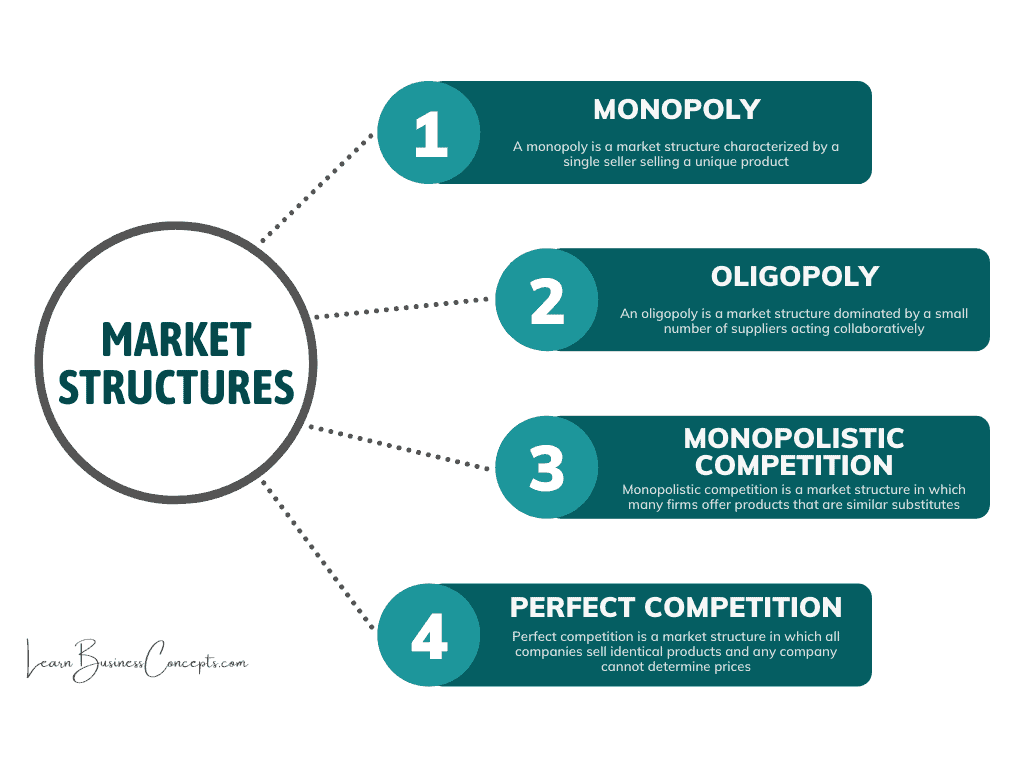
Perfect competition is a benchmark or ideal type against which actual market structures can be compared. Perfect competition is, in theory, the opposite of a monopoly, where only one firm provides a good or service, and that firm can charge any price it wants, because consumers have no alternatives and it is difficult for potential competitors to enter the market. .
Barriers To Entry: Understanding What Limits Competition
In a perfectly competitive model, there are no monopolies. This type of structure has a number of key characteristics, including:
This can be contrasted with the more realistic imperfect competition that exists when a market, hypothetical or real, violates the abstract tenets of neoclassical pure or perfect competition.
Because all real markets exist outside the plane of the perfect competitive model, each can be classified as imperfect. The contemporary theory of imperfect versus perfect competition stems from the Cambridge tradition of post-classical economic thought.
In a highly competitive market, there are a large number of buyers and sellers. The sellers are small firms, not large corporations, who are able to control prices by adjusting supply. They sell products with minimal differences in capabilities, features and prices. This ensures that buyers cannot differentiate between products based on physical attributes like size or color, or intangible values like branding.
Case Interview Frameworks: Ultimate Guide
A large number of buyers and sellers ensure that supply and demand remain constant in the market. This allows buyers to easily exchange products made by one company for another.
Information about an industry’s ecosystem and competition represents a significant advantage, for example, knowledge of component sourcing and supplier pricing can make or break the market for certain companies.
In certain knowledge- and research-intensive industries, such as pharmaceuticals and technology, information about competitor patents and research initiatives can help companies develop competitive strategies and build a competitive advantage around their products.

The availability of free and perfect information in a perfectly competitive market ensures that each firm can produce its goods or services at exactly the same rate and using the same production techniques as others in the market.
Profitable Small Business Strategies Under Different Types Of Competition
Governments play a critical role in shaping the market for products by imposing regulations and price controls. They can control the entry and exit of companies in a market by making rules to function in the market. For example, the pharmaceutical industry has to deal with a number of regulations that govern the development, manufacture and sale of medicines.
These rules, in turn, require large capital investments in the form of human resources, such as lawyers and quality assurance personnel, and infrastructure, such as drug manufacturing machinery. The accumulated costs add up, making it extremely expensive for companies to bring a drug to market.
In comparison, the tech industry operates with relatively less oversight compared to its pharma counterpart. Therefore, entrepreneurs in this industry can start businesses with little to no capital, which makes it easy for people to start a business in the industry.
Such controls do not exist in a fully competitive market. The entry and exit of companies in such a market is unregulated, and this gives them the opportunity to spend without restrictions on labor and capital assets and adjust their production in relation to market demand.
Business Plan Template For Startups And Small Businesses [2023]
Cheap and efficient transportation is another feature of perfect competition. In this type of market, companies do not have any significant costs for the transfer of goods. This helps to lower the product price and reduce delays in the transportation of goods.
The actual competition deviates from this ideal mainly due to the differentiation in production, marketing and sales. For example, the owner of a small health food store can widely advertise the kernels that are fed to the cows that produce the fertilizer for the non-GMO soybeans, thereby setting themselves apart from the competition. This is called differentiation.
The first two criteria (homogeneous products and price takers) are anything but realistic. However, for the second two criteria (information and mobility), global technology and trade transformation improves information and resource flexibility. Although reality is far from this theoretical model, the model is still useful because it can explain many real-world behaviors.

Companies try to establish brand equity by marketing around their differentiation. As such, they advertise to gain pricing power and market share.
Types Of Compensation: Everything Hr Needs To Know
Many industries also have significant barriers to entry, such as high startup costs (as in the automotive industry) or strict government regulations (as in the utilities industry), which limit the ability of companies to enter and exit such industries. And although consumer awareness has increased with the information age, there are still few industries where the customer knows all available products and prices.
There are significant obstacles preventing the economy from becoming fully competitive. Agribusiness is probably the closest thing to perfect competition, because it is characterized by many small producers who have little or no influence on the selling price of their products.
Commercial buyers of soft goods are usually very well informed and although agricultural production faces some barriers to entry, it is not particularly difficult for a producer to gain a foothold in the market.
Perfect competition is an idealized framework for a market economy. Although it provides a practical model of how an economy works, it is not always accurate and shows significant deviations from the real economy. As with other models, the value of a perfect competition frame is only true to the extent that it reflects actual conditions.
What Is Competitive Advantage? Definition, Examples & Identification
A notable feature of perfect competition is low profit margins. Since all consumers have access to the same products, they naturally gravitate to the lowest prices. Businesses cannot differentiate themselves by charging a premium for higher value products and services. For example, it would be impossible for a company like Apple (AAPL) to compete in a highly competitive market because its phones are more expensive than those of its competitors.
Another reason is the lack of innovation. The prospect of a larger market share and the opportunity to differentiate from the competition provides an incentive for companies to innovate and make better products. But no company has a dominant market share in perfectly competitive conditions, which means that the long-term profitability of their operations is zero.
Another disadvantage is the lack of economies of scale. Limiting profit margins to zero means companies have less money to invest in expanding their manufacturing capacity. Expanding production capacity could potentially lower costs for consumers and increase profit margins for companies. But the presence of multiple small firms cannibalizing the market for the same product prevents this and keeps the average firm size small.

In perfectly competitive markets, profits can be possible for a short period of time. But the dynamics of the market cancel and balance the effects of positive or negative gains. Since there is no information asymmetry in the market, other companies will quickly ramp up production or reduce manufacturing costs to catch up with the company that made profits.
How To Perform A Best In Class Competitor Analysis (w/ Template)
Average and marginal revenue for firms in a perfectly competitive market equal the price of the product to the buyer. This restores the previously disturbed balance of the highly competitive market. Over the long term, an adjustment in supply and demand ensures that any gains or losses in such markets tend to zero.
The opposite of perfect competition is a monopoly, where a single firm controls the supply of a given product. Under monopoly conditions, consumers cannot go elsewhere if the price is too high; They can simply choose not to buy the product.
This means that instead of setting prices based on supply and demand, the monopoly can simply set a price point that maximizes its profits. Some types of companies are considered natural monopolies because there is a significant first mover advantage that discourages competitors from entering the market. Other monopolies can be established by government action or by cartels such as OPEC.
As already mentioned, perfect competition is a theoretical construct and does not really exist. Therefore, it is difficult to find real examples of perfect competition, but there are variants in everyday society.
How To Do A Social Media Competitive Analysis
Imagine the situation in a farmer’s market, a place characterized by many small sellers and buyers. Typically, there is little difference between products and their prices from one farmer’s market to another. It does not matter how the produce is grown (unless it is classified as organic) and there is little difference in how it is packaged or labeled. So even if one of the farms that produce goods for the market goes out of business, this does not change the average prices.
The situation can also be relatively similar in the case of two competing supermarkets that manage their aisles from the same companies. Back there